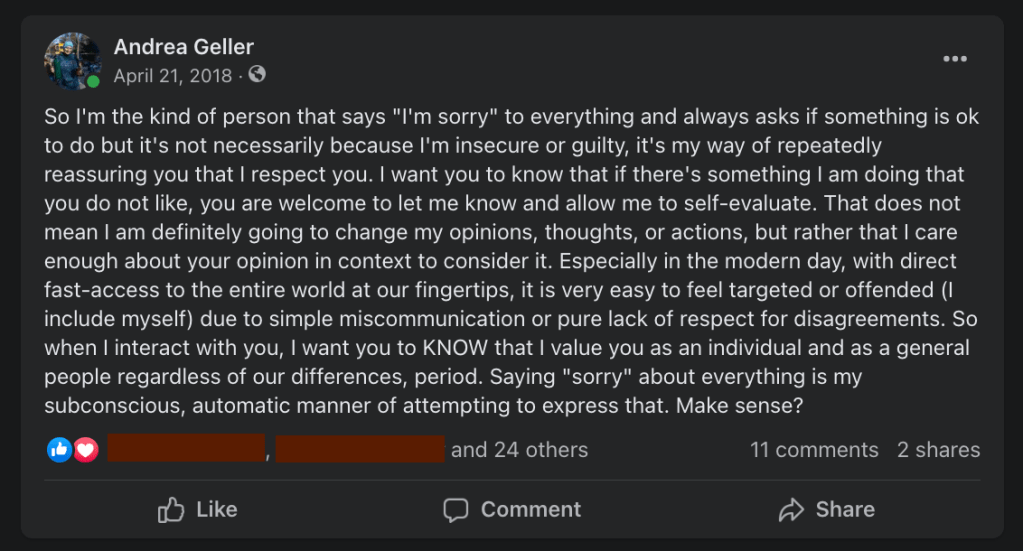
Do you apologize too much, too? I made a post about it on FaceBook years back and my stepmom expressed that she didn’t understand it. Maybe this excerpt will articulate my meaning better.


Has Society Become Too Sensitive?
Absolutely, society’s too sensitive nowadays. We whine the word “trigger,” we’re all on the defense for topics ranging from queer identities to gun rights, and we cancel Johnny Depp just as quickly as we cancel Amber Heard.
And so what? In most of these cases, people have pretty damn good reasons of their own to be upset about something, one way or another. And do I have some non-negotiables that I’d go batshit about? One hundred percent.
People being sensitive to one another isn’t inherently or always a bad thing.
We’re sensitive to one another because, since the turn of the century, we’ve found out lot more terrible things that human beings have been and are doing to one another. Did you know the first iPhone was only released in 2007?
Here’s a cool diagram on Smart technology from a public, peer-reviewed article. (Author list: Reyhaneh Karimi, Leila Farahzadi, Samad M.E. Sepasgozar, Sharifeh Sargolzaei, Sanee M. Ebrahimzadeh Sepasgozar, Mohsen Zareian and Akram Nasrolahi.) Link in caption under image.

Apologies About Anything
As my Facebook post from five years ago expresses, I say sorry as a compulsive way to show consideration. I say sorry to express empathy and sympathy. I say sorry’s instead of excuse-me’s, don’t-mind-me’s, oop’sies, didn’t-hear-youzies, bumped-into-thee’s. I say sorry sarcastically, especially when I’m suffering the same sufferings as the other person – like when we’re both standing in the sun and the companion in question dares to complain that it’s hot. Like, I feel you, bro.
I say sorry in serious conversations, too. That’s the power of words – saying sorry often doesn’t entirely devalue its meaning for me. There is a difference between mumbling “m’sowry” as I squeeze past other shoppers in the aisles of Food Lion and looking my loved one in the eye and saying, “I’m sorry for saying that, that was hurtful, I was frustrated, and should not have spoken to you in that way.”
But there are limits, balance is important, moderation exists. Somewhere. I have yet to find it, but I know it’s there somewhere. Picking and choosing when to say sorry and to what extent is also important. For example, a “sorry for joking” phrase would have been lost in the humor of my first paragraph under “Has Society Become Too Sensitive?” But in case any readers don’t think I recognize the responsibility I bear as a writer with sensitive subjects: if my comparison of LGBTQIA+ to gun rights upset you, I understand how they require very different approaches and reflect the values of very different demographics, and I am sorry if my writing, in your, as my audience’s, opinion, undermines the validity of those respective issues.
Never Apologize for Who You Are
“Who You Are” is your identity. If the characteristics that make up your identity, that define you, are violent or hateful or destructive, then I simply ask you to look inside yourself. Is that really you? Or rather, have you internalized a fear, an insecurity, a shame, a blame, or a learned behavior that you are desperate to let go and yet fighting to hold onto?
There is so much more to you than hate or violence… Or even frustration, anger, sadness. Or even happiness, joy, excitement. Your feelings do not define you. How you process those feelings and learn from them (over and over again) make up your emotions. That space in between feelings and emotions? That is choice.
And when you figure out how to process feeling-to-emotion in a way that does not hurt yourself and others, in ways that allow you genuine peace within yourself that does not require the undermining or even negligence of our communities around us, that is when you know you do not need to apologize for who you are.
And when you figure that out… Call me. I’d love to learn from you.

 absgeller
Leave a comment